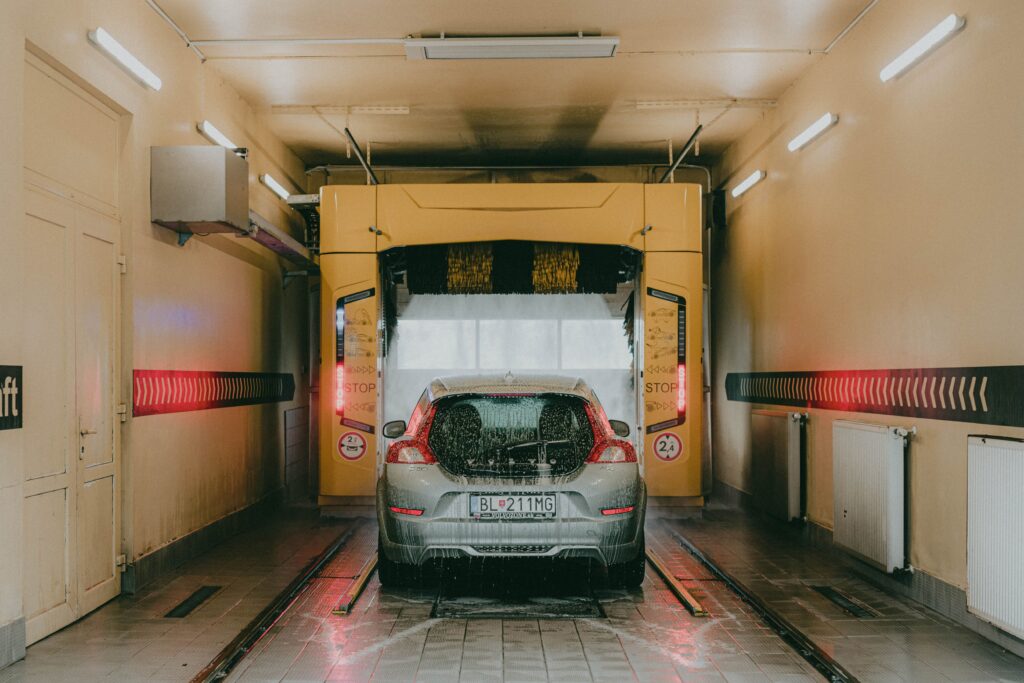
Building a car wash from scratch is one of the most capital-intensive moves in the small business world. Even the most modest new build — a single in-bay automatic on a leased lot — routinely reaches $200,000 to $400,000 before the first car rolls through. A full express tunnel build in a mid-size market can push past $3 million.
This guide breaks down every cost category involved in a new car wash build, explains where estimates go wrong, and helps you understand what you are actually signing up for before you commit to land, equipment, or a contractor.
If you want the complete picture of how startup costs translate into monthly profit and payback timelines, see the full car wash business guide.
Why New Builds Cost More Than People Expect
Most cost estimates start with the equipment quote and stop there. That is a serious mistake. Equipment is only one piece of the total cost — and often not the largest one.
Here is what the equipment quote leaves out:
- Site preparation, grading, and paving
- Utility hookups — water, sewer, and electrical
- Water reclaim system installation
- Permitting and environmental compliance fees
- Canopy and structural work
- Payment kiosks and technology systems
- Signage and exterior finishing
- Pre-opening working capital
When you add these items to the equipment cost, the total can be two to three times what you first budgeted. For a granular breakdown of what each equipment type actually costs before any of these extras, see Car Wash Equipment Cost: Self-Serve vs In-Bay vs Tunnel.
Cost Breakdown by Build Type
Self-Serve Bay Build
Self-serve is the most accessible entry point for independent operators. Customers wash their own car using coin- or card-operated wand bays.
| Cost Item | Low Estimate | High Estimate |
|---|---|---|
| Land (annual lease) | $12,000/yr | $40,000+/yr |
| Land (purchase) | $150,000 | $500,000+ |
| Self-serve bay equipment (per bay) | $15,000 | $40,000 |
| Site construction and paving | $30,000 | $120,000 |
| Utility hookups | $10,000 | $50,000 |
| Water reclaim system | $20,000 | $60,000 |
| Payment kiosks and card readers | $5,000 | $20,000 |
| Permits and licensing | $5,000 | $30,000 |
| Signage and exterior | $3,000 | $15,000 |
| Insurance (first year) | $5,000 | $15,000 |
| Working capital reserve | $25,000 | $50,000 |
| Total (3-bay self-serve, leased land) | $130,000 | $440,000 |
A three-bay self-serve on leased land is a realistic entry-level build. In competitive urban markets or on purchased land, that number climbs quickly. Poor location selection is one of the top reasons car washes fail — confirm your site has a daily traffic count of at least 10,000 vehicles before signing a lease.
In-Bay Automatic Build
An in-bay automatic uses a single machine that moves around the car while the driver stays inside. Higher revenue per car than self-serve, lower staffing than a tunnel.
| Cost Item | Low Estimate | High Estimate |
|---|---|---|
| Land (annual lease) | $15,000/yr | $50,000+/yr |
| In-bay automatic machine (per unit) | $80,000 | $150,000 |
| Site construction and paving | $40,000 | $150,000 |
| Utility hookups | $15,000 | $60,000 |
| Water reclaim system | $25,000 | $70,000 |
| Payment kiosks | $5,000 | $25,000 |
| Permits and licensing | $8,000 | $40,000 |
| Canopy and building structure | $20,000 | $80,000 |
| Signage and exterior | $5,000 | $20,000 |
| Insurance (first year) | $5,000 | $20,000 |
| Working capital reserve | $25,000 | $60,000 |
| Total (2-machine build, leased land) | $270,000 | $735,000 |
Two in-bay machines on leased land is the most common mid-tier build for independent operators. Budget at least $270,000 and plan for closer to $400,000 to $500,000 in most markets. To understand how quickly you can recover this investment, the car wash break-even analysis walks through the payback math by build type.
Express Tunnel Build
An express tunnel is a conveyor system that moves cars through a fixed wash sequence. It is the highest-revenue model but also the most capital-intensive.
| Cost Item | Low Estimate | High Estimate |
|---|---|---|
| Land purchase | $300,000 | $2,000,000+ |
| Tunnel building construction | $400,000 | $1,500,000 |
| Tunnel wash equipment | $150,000 | $500,000 |
| Vacuum stations and canopy | $40,000 | $120,000 |
| Utility infrastructure | $30,000 | $100,000 |
| Water reclaim system | $40,000 | $100,000 |
| Payment and POS systems | $20,000 | $60,000 |
| Permits and licensing | $15,000 | $60,000 |
| Staffing and pre-opening training | $10,000 | $30,000 |
| Marketing and grand opening | $10,000 | $40,000 |
| Working capital reserve | $50,000 | $150,000 |
| Total (express tunnel build) | $1,065,000 | $4,660,000 |
A realistic express tunnel build in a mid-size suburban market typically lands between $1.5 million and $3 million all-in. The income potential that justifies this investment is covered in detail in How Much Does a Car Wash Make Per Month? — tunnels running a strong membership program are in a different revenue category than pay-per-wash only operations.
The Costs That Catch New Owners Off Guard
Water and Sewer Infrastructure
This is consistently the most underestimated item in car wash builds. A car wash uses 40 to 100 gallons of water per vehicle. In many jurisdictions, water reclamation systems are required by law, not optional. They typically cost $20,000 to $80,000 to install. On top of that, connecting to municipal water and sewer at the volumes a car wash requires can involve infrastructure upgrades costing $10,000 to $50,000 alone.
Confirm local water and sewer requirements and get written cost estimates from a licensed plumber familiar with commercial car wash builds before committing to any site.
Permitting Delays
Permitting is not just a cost — it is a timeline problem. Environmental permits, stormwater discharge permits, and zoning approvals can take four to six months from application to approval. During that window, you are paying rent or carrying land costs with zero revenue. This delay risk is one of the key factors in the buying vs. building decision — an existing car wash sidesteps this entirely.
Working Capital
A car wash does not hit full revenue potential on day one. It takes three to six months to build customer traffic and membership volume to steady-state levels. You need enough cash to cover all operating costs — utilities, insurance, rent, staffing — during that ramp-up period. Six months of operating costs is the minimum reserve. For express tunnels, that means $50,000 to $150,000 set aside before you open the doors.
Choosing the Right Site Before You Build
No build cost analysis is complete without a location check. A well-built car wash in the wrong location will lose money every month regardless of equipment quality. Key site requirements:
- Self-serve / in-bay: minimum 10,000 daily vehicles on your street, lot size of at least 4,000 to 10,000 sq ft
- Express tunnel: minimum 25,000 to 40,000 daily vehicles, lot size of 30,000 to 60,000 sq ft, corner preferred
- No more than two established washes within a one to two mile radius
The full framework for evaluating and selecting a site before committing is covered in Car Wash Location Strategy: How to Pick a Site That Actually Makes Money.
New Build vs. Buying an Existing Car Wash
For many operators, buying an existing car wash is a smarter financial move than building new — especially at current construction costs. An existing operation generates revenue from day one, has a real customer base, and eliminates most permitting and construction risk. The trade-off is a premium purchase price, typically three to five times annual net earnings, plus inheriting whatever condition the equipment is in.
The case for building new usually comes down to one of two situations: no quality existing operations are available in your target market, or you want a location advantage that does not exist in any current wash. A full comparison of the financial math on both paths is in Buying vs. Building a Car Wash: Which Makes More Financial Sense?.
Summary
Building a car wash from scratch requires significantly more capital than the equipment quote suggests — ranging from $130,000 for a minimal self-serve build to over $4 million for a premium express tunnel. The operators who succeed go in with a complete cost picture covering equipment, site work, utilities, permitting, and working capital.
For a detailed breakdown of equipment costs by type, see Car Wash Equipment Cost: Self-Serve vs In-Bay vs Tunnel. For payback timelines based on your total build cost, see the car wash break-even analysis. And if you are still evaluating whether to build at all, Is a Car Wash a Good Investment in 2026? gives an honest assessment of the risks and opportunities.
