Start Laundromat Business Today
Quick Answer: A well-located mid-size laundromat with 20 to 30 machines nets $3,000 to $7,000 per month after all expenses. Startup costs range from $50,000 for an existing operation to $500,000 for a new build. Most owners break even in 3 to 7 years.
A laundromat is one of the oldest passive income businesses in existence. People will always need clean clothes. The machines do the work. You collect the income.
But it is not as simple as buying machines and opening the door. The laundromat business has real costs, real risks, and a specific type of location dependency that determines whether you make money or lose it.
This guide breaks down exactly how a laundromat business works — startup costs, daily operations, realistic profit figures, and the risks that catch new owners off guard. No hype. No estimates pulled from thin air.
What This Guide Covers
What is a laundromat business and how does it work?
Types of laundromat business models
Startup costs — full breakdown
How a laundromat runs day to day
How much profit a laundromat makes
Risks and why laundromats fail
How to start a laundromat — step by step
Is a laundromat worth starting in 2026?
What Is a Laundromat Business?
Product markup in a standard
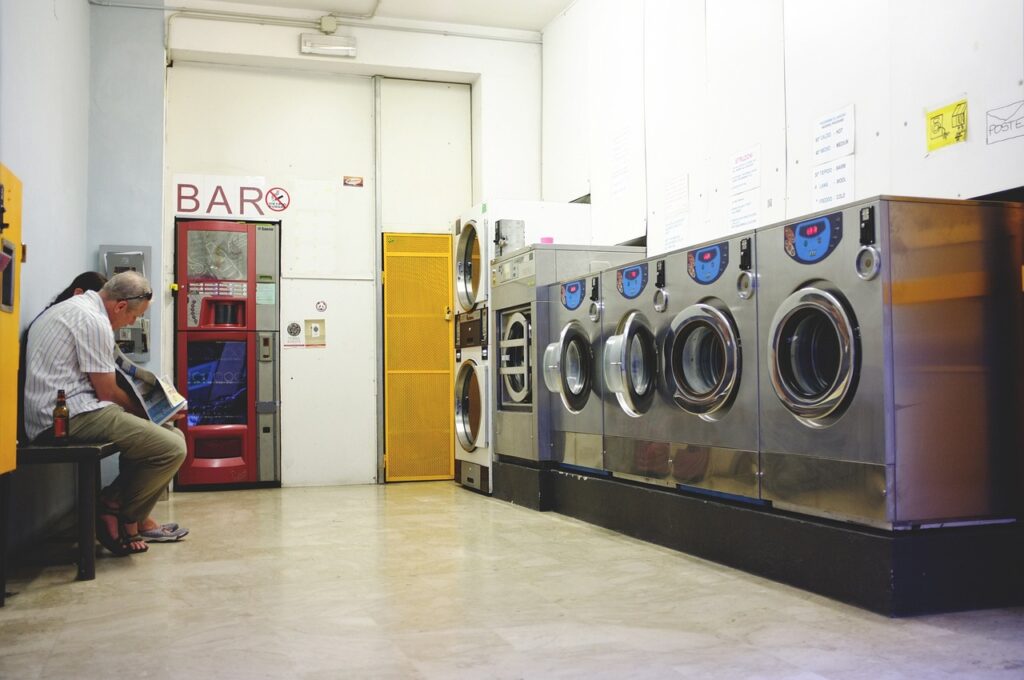
A laundromat is a self-service laundry facility where customers pay to use coin or card-operated washing machines and dryers. Customers bring their own laundry, pay per cycle, and do the washing themselves.
The business model is straightforward:
- You install commercial washing machines and dryers in a leased space
- Customers pay per wash or dry cycle — typically $2.50 to $6.00 per washer load
- The machines run continuously without you being present
- You restock supplies, maintain machines, and collect revenue
- Unlike most businesses, a laundromat does not require you to actively sell anything. Once customers find you, the habit of returning is automatic. People do laundry every week.
Why Laundromats Are Considered a Stable Business
Laundromats are classified as a recession-resistant business for a specific reason — people do not stop doing laundry when money is tight.
In fact, economic downturns often increase laundromat usage because people move from houses with private machines to apartments without them.
Roughly 35 million Americans use laundromats regularly according to the Coin Laundry Association
Apartment renters are the primary customer base — and renting is increasing in most markets
Low staff requirements mean operating costs stay manageable
Cash or card revenue is collected immediately — no invoicing or accounts receivable
Types of Laundromat Business Models
Not all laundromats operate the same way. There are four main models, each with different costs, income potential, and time requirements.
| Model | Description | Startup Cost Range | Income Potential | Owner Time Required |
| Self-service only | Customers do everything themselves. Machines are coin or card operated. Minimal staff needed. | $50,000 — $300,000 | $2,000 — $6,000/month net | 5 — 15 hrs/week |
| Drop-off / wash & fold service | Owner or staff handle washing and folding for customers who drop off laundry. Premium pricing. | $60,000 — $350,000 | $4,000 — $10,000/month net | 20 — 40 hrs/week |
| Pickup and delivery laundry | You collect laundry from homes, wash it, and return it. Often added to existing laundromat. | $5,000 — $20,000 add-on | $1,000 — $5,000/month add-on | 15 — 25 hrs/week |
| Hybrid (self-service + drop-off) | Combines all revenue streams. Most profitable model but most complex to operate. | $80,000 — $400,000 | $6,000 — $15,000/month net | 25 — 40 hrs/week |
Most Common Model: Self-service with drop-off service added. This covers the majority of profitable independent laundromats in the US and gives owners passive income plus a premium revenue stream.
Startup Costs (Full Breakdown)
Startup cost is where most new laundromat owners get a serious shock. The advertised price of an existing laundromat or the quote for new equipment is never the full story.
Buying an Existing Laundromat
Buying an existing operation is the most common entry point. The machines are already installed, the customer base exists, and revenue starts from day one.
| Cost Item | Low Estimate | High Estimate | Notes |
| Purchase price (existing laundromat) | $50,000 | $300,000 | Depends on revenue, equipment age, and lease terms |
| Due diligence and legal fees | $2,000 | $8,000 | Lawyer review, business inspection |
| Equipment repairs or upgrades | $5,000 | $40,000 | Older machines often need immediate work |
| Rebranding and cosmetic refresh | $3,000 | $20,000 | Signage, paint, flooring updates |
| Working capital reserve | $15,000 | $40,000 | 6 months of operating costs minimum |
| TOTAL (buying existing) | $75,000 | $408,000 |
Building Machine
Building a New Laundromat From Scratch
Starting fresh gives you full control over equipment, layout, and branding. It also costs significantly more and takes longer to open.
| Cost Item | Low Estimate | High Estimate | Notes |
| Commercial washers (20 units) | $30,000 | $100,000 | $1,500 — $5,000 per unit depending on size |
| Commercial dryers (20 units) | $24,000 | $80,000 | $1,200 — $4,000 per unit |
| Lease deposit + first months rent | $6,000 | $20,000 | 2 to 4 months upfront typically |
| Leasehold improvements / buildout | $20,000 | $150,000 | Electrical, plumbing, HVAC, flooring |
| Utility infrastructure upgrades | $10,000 | $80,000 | Three-phase power, gas lines, water supply |
| Payment system installation | $5,000 | $20,000 | Card readers, kiosks, network |
| Permits and licensing | $4,000 | $35,000 | Varies widely by city and state |
| Signage and exterior | $3,000 | $15,000 | |
| Insurance (first year) | $4,500 | $18,000 | |
| Equipment delivery and installation | $5,000 | $20,000 | |
| Working capital reserve | $20,000 | $50,000 | |
| TOTAL (new build) | $131,500 | $588,000 |
Key Warning: Most new laundromat owners underestimate utility infrastructure upgrades. Running 20 to 30 commercial machines requires serious electrical and plumbing capacity. Get a licensed assessment of any space before signing a lease. This one step can save you from a $50,000 to $100,000 surprise.
How a Laundromat Runs Day to Day
One of the main appeals of a laundromat is that it can run largely without you. But it still requires regular attention to stay clean, functional, and profitable.
Daily Tasks
- Open and close the facility — many laundromats are open 6am to 10pm or 24 hours
- Clean the facility — floors, machines, folding tables, bathrooms
- Empty lint traps on dryers — fire safety requirement, must be done daily
- Check and restock vending supplies if you sell detergent or snacks
- Collect and count revenue from coin machines or review card payment reports
- Address any customer complaints or machine issues
Weekly Tasks
- Deep clean machines — drum interiors, door seals, detergent dispensers
- Inspect all machines for wear, unusual sounds, or performance issues
- Review revenue reports and compare to previous weeks
- Restock all supplies
- Handle any minor repairs or schedule technician visits
Monthly Tasks
- Pay all utility bills and operating expenses
- Review profit and loss for the month
- Service hot water heaters and water softeners
- Schedule any planned maintenance with commercial equipment technician
- Review pricing — are competitors charging more or less?
Staffing Reality
Many small laundromats are owner-operated with zero staff. The owner visits once or twice a day for cleaning and maintenance. This works when the facility is small and well-maintained.
Larger laundromats or those offering drop-off service require at least part-time staff. A single attendant working 6 to 8 hours per day costs $1,500 to $3,000 per month in wages.
Owner Time Reality: A self-service only laundromat typically requires 5 to 15 hours per week from the owner. Adding drop-off service increases this to 20 to 40 hours. Most laundromat owners have a second income or job when starting out.
How Much Profit Does a Laundromat Make?
Profit depends on three things: location traffic, number of machines, and how well you control operating costs. Here are realistic figures based on real laundromat operations.
Revenue Calculation — How Laundromats Earn Money
Revenue comes primarily from washer and dryer cycles. Here is how to calculate it:
| Revenue Factor | Example Numbers |
| Number of washers | 20 machines |
| Average cycles per machine per day | 5 to 8 cycles |
| Average price per wash cycle | $3.50 |
| Daily washer revenue | $350 — $560 |
| Number of dryers | 20 machines |
| Average dryer revenue (roughly 70% of washer revenue) | $245 — $392 |
| Total daily revenue (washers + dryers) | $595 — $952 |
| Monthly gross revenue (30 days) | $17,850 — $28,560 |
Net Profit After Expenses — Three Size Examples
| Small (15 machines) | Mid-Size (25 machines) | Large (40 machines) | |
| Monthly gross revenue | $8,000 — $14,000 | $16,000 — $28,000 | $28,000 — $50,000 |
| Monthly operating costs | $5,000 — $10,000 | $10,000 — $20,000 | $20,000 — $40,000 |
| Monthly net profit | $2,000 — $4,000 | $4,000 — $9,000 | $8,000 — $15,000 |
| Annual net profit | $24,000 — $48,000 | $48,000 — $108,000 | $96,000 — $180,000 |
Important Context: These figures assume a well-located laundromat at 60% to 80% machine utilization. A poorly located laundromat can run at 20% to 30% utilization and lose money every month. Location is the single most important variable.
Additional Revenue Streams
Smart laundromat owners add revenue streams on top of machines:
| Revenue Stream | Monthly Revenue Potential | Setup Cost |
| Drop-off wash and fold service | $1,500 — $5,000 | $0 — $2,000 (staff cost) |
| Vending machines (detergent, snacks) | $200 — $800 | $1,500 — $3,000 |
| Pickup and delivery service | $1,000 — $4,000 | $3,000 — $8,000 (vehicle) |
| Commercial accounts (hotels, gyms) | $500 — $3,000 | $0 (sales effort only) |
| ATM machine in facility | $100 — $300 | $2,000 — $4,000 |
Break-Even Timeline
| Startup Cost | Monthly Net Profit | Break-Even Time |
| $75,000 (existing purchase) | $3,500/month average | 21 months |
| $150,000 (new build, small) | $3,000/month average | 50 months (4.2 years) |
| $300,000 (new build, mid-size) | $6,000/month average | 50 months (4.2 years) |
| $500,000 (new build, large) | $10,000/month average | 50 months (4.2 years) |
Most laundromat investors target a 3 to 7 year break-even. Buying an existing profitable operation is almost always faster to profitability than building new.
Step by Step
How to Start a Laundromat
Step 1 — Research Your Market
Before spending a single dollar, research the market. You need to confirm that your target location has the right customer base.
- Identify neighborhoods with high apartment density and low in-unit washer/dryer rates
- Count existing laundromats within a 1-mile radius — is the market saturated?
- Drive the area at different times of day — foot traffic, parking, safety
- Talk to residents in the area — do they currently use a laundromat? Which one?
- Research demographics — renters, income levels, household size
Step 2 — Choose Your Business Model
Decide before you commit to a location whether you will be self-service only, include drop-off service, or add pickup and delivery. This affects your space requirements, staffing needs, and startup budget.
Step 3 — Find the Right Location
- Target spaces of 1,200 to 3,000 square feet for a standard laundromat
- Confirm the space has adequate electrical capacity — ideally three-phase power
- Confirm adequate water supply and drain capacity
- Check zoning permits a laundromat at this address
- Evaluate parking availability — essential for customers carrying laundry
- Negotiate a lease of minimum 5 years with renewal options before signing
Step 4 — Get the Proper Permits and Licenses
| Permit / License | Where to Get It | Typical Timeline |
| Business license | Local city or county office | 1 — 4 weeks |
| Building permit (for renovations) | Local building department | 2 — 12 weeks |
| Plumbing permit | Local building department | 1 — 6 weeks |
| Electrical permit | Local building department | 1 — 6 weeks |
| Fire safety inspection | Local fire department | 1 — 4 weeks |
| Zoning approval | Local planning department | 2 — 12 weeks |
| Water and sewer connection | Local utility authority | 2 — 8 weeks |
Timeline Warning: Permits can take 8 to 24 weeks total. You will be paying rent during this entire period with no income. Factor this into your working capital requirement — budget at least 3 months of rent before you open.
Step 5 — Purchase or Finance Equipment
Commercial laundry equipment can be purchased outright, financed, or leased. Most operators finance at least part of their equipment.
| Financing Option | Pros | Cons |
| Buy outright (cash) | No monthly payment, maximum profit | Large upfront cash requirement |
| Equipment financing (loan) | Preserve cash, build credit | $800 — $4,000/month payment reduces profit |
| Equipment lease | Lower upfront cost | You never own the machines — less control |
| SBA loan | Low interest, long terms | Lengthy approval process, collateral required |
Step 6 — Set Up Payment Systems
Payment systems have changed significantly. Card payment is now expected by most customers. Your options:
- Coin-only: low setup cost but increasingly unattractive to customers
- Card-only kiosk: customers buy credits at a central kiosk then use them per machine — most modern approach
- Individual card readers per machine: most convenient but highest hardware cost
- App-based payment: growing in popularity, allows loyalty programs and remote monitoring
Step 7 — Market Your Opening
- Google Business Profile — create and optimize before you open
- Door hangers and flyers in nearby apartment complexes — most effective low-cost method
- Facebook and Instagram — photos of clean, modern facility build credibility
- Opening week promotion — free wash or discounted first visit
- Reach out to apartment property managers — they refer residents
- Yelp and Google reviews — ask every satisfied customer to leave one
Step 8 — Open and Monitor Closely
The first 90 days are critical. Monitor machine usage patterns, identify peak hours, track daily revenue, and stay on top of maintenance. Problems caught early cost much less than problems discovered late.
SECTION 8 — Is a Laundromat Worth Starting in 2026?
The honest answer is: it depends entirely on your location and your capital.
A Laundromat Is Worth It If:
- You have identified a high-density rental area with no laundromat or outdated competition
- You have $75,000 to $150,000 in capital to invest without risking financial hardship
- You are patient — this is a 3 to 7 year payback business, not a quick return
- You are buying an existing profitable operation at a fair multiple of earnings
- You want genuinely passive income after the first year of active setup
A Laundromat Is Not Worth It If:
- You cannot clearly identify where your customers will come from
- You are underfinanced — starting with less than 6 months operating reserve is dangerous
- You need income within the first 6 months — laundromats take time to build revenue
- You are buying an existing laundromat with old equipment and a short remaining lease
- The location you are considering already has 2 or more well-reviewed competitors within 1 mile
The 2026 Opportunity
The laundromat industry is currently undergoing a transition. Older coin-only laundromats with outdated equipment are losing customers to newer card and app-based facilities. This creates two opportunities:
- Buying older struggling laundromats at low prices and modernizing them
- Opening new modern facilities in areas where the existing competition is outdated
The operators winning in 2026 are those investing in card payment systems, clean well-lit facilities, app-based loyalty programs, and drop-off services that older competitors do not offer.
Final Verdict
| Factor | Rating | Notes |
| Passive income potential | High | After setup, requires only 5 — 15 hrs/week |
| Startup cost barrier | High | $75,000 — $500,000 depending on route chosen |
| Recession resistance | Very High | Demand stays consistent regardless of economy |
| Profit potential | Medium to High | $3,000 — $15,000/month depending on size |
| Time to profitability | Slow | 3 to 7 years to full break-even |
| Complexity to operate | Medium | Equipment knowledge and property management required |
| Scalability | Medium | Adding locations is possible but capital intensive |
