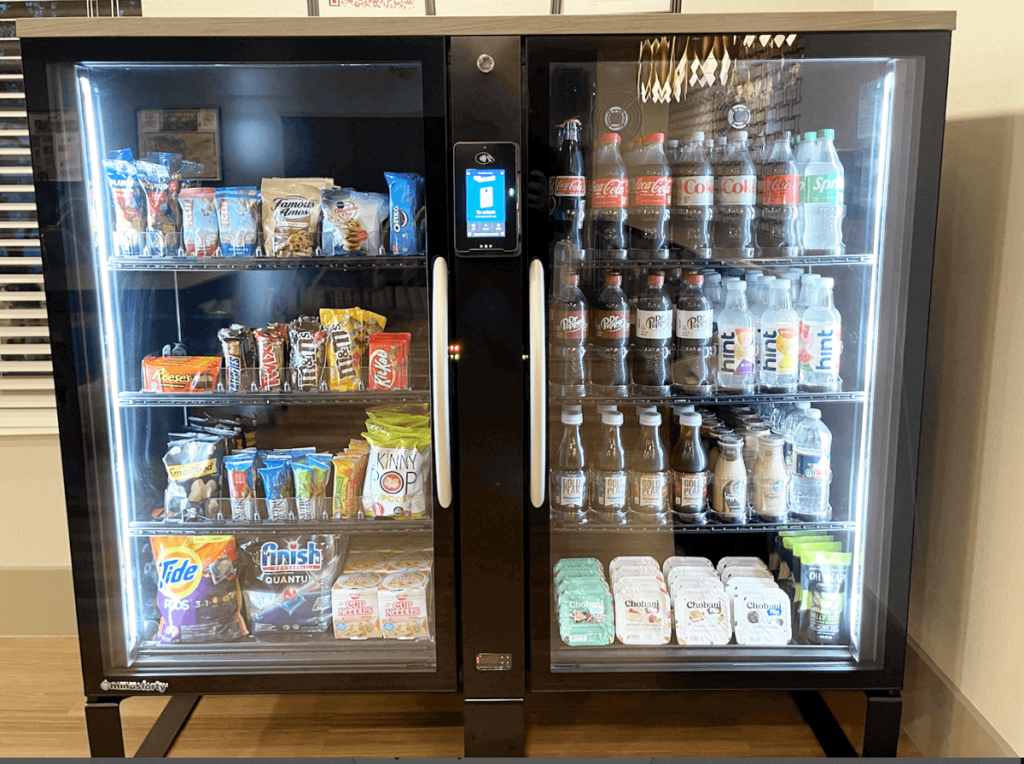
What Is a Vending Machine Business?
A vending machine business is exactly what it sounds like — you own machines, you place them in locations where people buy things, and you collect the difference between what the products cost you and what customers pay. There is no storefront, no staff requirement, and no set hours. The machine operates around the clock whether you are there or not.
That description is accurate, and it is also where most people stop reading before they buy their first machine. What it leaves out is everything that actually determines whether the business makes money — the location, the product mix, the commission structure, the restocking logistics, and the patience required before any of this becomes predictable income.
How a Vending Machine Business Makes Money
The revenue model is simple. You buy products wholesale, stock them in your machine, and sell them at a markup. The difference between your cost and your selling price — minus location commissions and operating expenses — is your profit.
Vending Machine Business
How a Vending Machine Business Makes Money
Product markup in a standard
The typical product markup in a standard snack and drink machine runs between 50% and 100% on the retail price. An Oreo cookie packet that costs you $0.31 wholesale sells for $1.00. A Gatorade that costs $0.54 wholesale sells for $1.50. Those margins sound healthy until you factor in what actually comes out of each sale before the money reaches your pocket.
The revenue model
The revenue model is simple. You buy products wholesale, stock them in your machine, and sell them at a markup. The difference between your cost and your selling price — minus location commissions and operating expenses — is your profit.
From every dollar sold, a typical operator pays:
Cost of goods (COGS): 40% to 50% of gross sales goes back to restocking inventory
Location commission: 10% to 25% of gross sales goes to the property owner for hosting the machine
Card processing fees: 2% to 4% of cashless transactions — and cashless now accounts for the majority of sales in most locations
Machine maintenance reserve: Roughly $100 to $300 per machine per year for repairs, replacements, and upkeep
Fuel and vehicle costs: Depends on how far your route runs and how frequently you restock
Net profit Calculation
What remains after those deductions is your net profit. For a machine generating $600 per month in gross sales — a reasonable figure for a solid mid-tier location — the math works out approximately as follows:
| Item | Amount |
|---|---|
| Gross monthly sales | $600 |
| Cost of goods (45%) | -$270 |
| Location commission (15%) | -$90 |
| Card processing fees (3%) | -$18 |
| Maintenance reserve | -$25 |
| Fuel allocation | -$20 |
| Net monthly profit | ~$177 |
Calculation Details
That $177 is the real number. Not $600. Not the gross revenue figure that gets quoted in most guides.
A machine generating $600 per month in gross sales nets approximately $150 to $200 per month for a well-managed standard operation.
That $177 is the real number. Not $600. Not the gross revenue figure that gets quoted in most guides. A machine generating $600 per month in gross sales nets approximately $150 to $200 per month for a well-managed standard operation.

That figure can go higher with better locations, cashless payment systems, and premium products. It can go lower with poor location selection, high commission agreements, or machines that sit half-empty between restock visits.
Machine cost
Startup Cost Breakdown — What It Actually Costs to Begin
This is where promotional content consistently misleads people. The headline startup cost for a vending machine business is presented as low — $2,000, or sometimes even less. That figure is not wrong, but it only accounts for the machine itself in a best-case used-equipment scenario. The full picture is more detailed.
Used or refurbished machine
$500 to $3,000 per unit
The lower end of this range gets you an older machine that functions but lacks modern cashless payment capability. A quality refurbished machine with working bill acceptor, coin mechanism, and reliable refrigeration runs $1,500 to $3,000. This is the standard entry point for first-time operators.
New traditional snack or drink machine
$3,000 to $6,000 per unit
A new machine from a reputable manufacturer comes with a warranty, modern cashless payment compatibility, and lower expected maintenance in year one. The higher upfront cost is often recovered over 12 to 18 months in avoided repair bills.
New smart machine with touchscreen and remote monitoring
$6,000 to $30,000+
These machines include telemetry — the ability to track inventory levels, sales data, and machine performance remotely without a physical visit. For operators managing ten or more machines, the operational efficiency pays for itself. For someone starting with one machine, the cost is difficult to justify.
Additional startup costs beyond the machine
- $300 to $800 per machine, plus monthly processing fees Cashless payment capability is no longer optional in most locations. Machines without card readers consistently underperform compared to those that accept contactless payments. Multiple studies from vending operators show a 20% to 30% increase in sales from locations where cashless payment was added.
 Card reader installation
 - $200 to $800 per machine Your first stock will fill the machine completely. Buying through wholesale suppliers like Costco, Sam’s Club, or a dedicated vending distributor reduces your per-unit cost compared to retail.Initial inventory:
- $200 to $500 per machine
An 800-pound machine does not move itself. Delivery costs vary based on distance, machine weight, and installation complexity.Delivery and installation - $50 to $500 depending on your state and county
Most states require a business license and some require a separate vendor’s permit for vending machines. Check your specific state requirements before operating.Business licensing and permits - $50 to $500 depending on state
Operating as a sole proprietor is possible but exposes your personal assets to liability. Forming an LLC is a standard step for anyone running a vending route.LLC formation (recommended) - $0 to $60+ per machine per month
Basic operations can be tracked in a spreadsheet. Dedicated software like VendSoft or Cantaloupe becomes cost-effective once you have five or more machines and need route optimisation and sales tracking.Vending management software
One Machine setup
What a realistic one-machine startup actually costs
Total realistic startup ($3,000 – $6,100)
The $3,000 to $6,100 range for a single machine startup is what an operator actually needs to get started responsibly — not just the machine cost alone. Working capital reserve matters because your first month of operation will have costs before revenue stabilises, and machines occasionally need repairs at inconvenient times.
$1,800 – $3,500
Used machine with cashless reader
$300 – $600
Initial inventory
$200 – $400
Delivery and installation
$100 – $300
Business license and permits
$100 – $300
LLC formation
$500 – $1,000
Working capital reserve
Realistic Monthly Income by Location Type
Location is not one of the factors that determines vending machine profit. It is the only factor that matters at the scale most independent operators work at. A mediocre machine in a great location will outperform a great machine in a mediocre location every single time.
Here is what documented operator data shows for monthly gross revenue across different location categories:
- High-traffic locations ($600 to $2,500+ gross per month)
- Mid-tier locations ($200 to $600 gross per month)
- Low-traffic locations (under $200 gross per month)
Hospitals and medical facilities 24-hour foot traffic, captive audience, limited nearby food alternatives. A hospital vending machine can net $500 to $700 per month. These locations are competitive and not easy to secure without an existing relationship or a proposal process.
Large office buildings (150+ employees) A consistent daily user base with predictable purchasing patterns. Office machines in mid-to-large buildings generate $800 to $1,500 gross per month. Documented scenario: a machine serving 150 employees at a medium-sized office generates approximately $1,200 gross per month, with net profit around $445 per month after all expenses.
Manufacturing and warehouse facilities Workers on shift with limited access to outside food options are among the most reliable vending customers. Revenue per machine in these locations frequently exceeds $1,000 gross per month.
University campuses and dormitories High volume, 24-hour demand, and a demographic that consistently purchases convenience food. A university dormitory laundry kiosk scenario generates approximately $2,500 gross per month in documented operator data.
Operating Costs — Monthly
Understanding the monthly cost structure matters as much as understanding revenue. Here are the ongoing expenses that every vending machine operator carries:
nventory restocking
Your largest recurring cost. For a machine generating $600 gross per month, restocking costs approximately $240 to $300 per month (40% to 50% of gross). This is money you spend before you earn — you buy the product, stock the machine, then recover the cost through sales.
Location commission
Every location where your machine sits needs something in return. Most arrangements fall into two structures: a percentage of gross sales (typically 10% to 25%) or a flat monthly fee (typically $50 to $400 depending on traffic). High-traffic premium locations command the higher end of both ranges. A location paying 20% commission on $1,000 monthly gross costs you $200 per month — before you buy a single product.
Card processing fees
Every cashless transaction carries a processing fee of 2% to 4%. On a machine doing $600 per month where 70% of transactions are cashless, that costs approximately $10 to $17 per month. Modest individually, but across a ten-machine route it adds up to $100 to $170 monthly.
Fuel and vehicle wear
Restocking machines requires driving a route. A solo operator running ten machines spread across a city might drive 200 to 400 miles per week for restocking and maintenance visits. At current fuel costs and standard vehicle wear estimates, that represents $150 to $300 per month in transportation expense.
Machine maintenance
Budget $100 to $300 per machine per year for maintenance — coin mechanism cleaning, belt replacements, motor servicing, refrigeration checks. This averages $8 to $25 per machine per month. Older machines require more. Newer machines require less but may have higher repair costs when something does go wrong due to component complexity.
Software and technology
If you use route management software, this runs $0 to $60+ per machine per month depending on the platform. For a single machine, a spreadsheet is sufficient. For ten or more machines, software pays for itself in route efficiency and reduced unnecessary restocking trips.
Common Mistakes
Common Mistakes That New Operators Make
Overestimating location quality before data proves it
Every location looks promising before the machine goes in. The gym owner tells you his members are always looking for snacks.
New operators frequently lock into high-commission agreements for locations that turn out to be mediocre earners. Negotiate short initial terms — 30 to 90 days — before committing to long-term arrangements.
The failure rate in vending is lower than most small businesses
documented at over 80% success rate across operators. But the operators who struggle share recognisable patterns. Understanding these before you start is more valuable than any optimistic income projection.
The office manager says her team eats constantly. The reality is that foot traffic and actual purchase behaviour are two different things, and you cannot know the second until you have several weeks of sales data from that specific location.
- 2018 – Current
Treating it as passive income from day one
ending is not passive income at the start. It becomes low-maintenance income once routes are established, machines are reliable, and locations are proven. In the first six to twelve months, a solo operator with five machines will spend 10 to 15 hours per week on restocking, maintenance, location management, and bookkeeping. That is real work — and operators who go in expecting otherwise are frequently the ones who sell their machines within a year.
- 2018 – Current
Buying the wrong machine for the location
A snack and drink combo machine belongs in an office or warehouse. A healthy vending machine belongs in a gym or medical facility. A bulk candy machine does not belong anywhere you are trying to build serious income. Mismatching machine type to location is one of the most expensive and most avoidable mistakes in this business.
Ignoring the restock schedule
A machine that runs out of popular items loses sales that never come back. Customers who find an empty machine once begin making other arrangements.
Maintaining consistent restocking schedules — and prioritising high-selling SKUs when supply is limited — is an operational discipline that separates operators who build routes from those who stagnate.
Underpricing products
New operators frequently price products too low out of concern that customers will not pay higher prices. In most vending locations, customers are paying for convenience — the proximity of the machine to where they already are.
A bottle of water that sells for $1.50 in a grocery store sells for $2.00 to $2.50 in a vending machine, and the customer pays it because the alternative is leaving the building. Underpricing costs you margin without winning you loyalty.
Is a Vending Machine Business Worth Starting in 2026?
This is the question everyone arrives at, and it deserves a direct answer rather than a hedge
Yes — under specific conditions.
A vending machine business is worth starting if you have $4,000 to $8,000 to invest without expecting returns in the first three months. It is worth starting if you have or can develop access to two or three solid locations with real foot traffic before you buy the first machine. It is worth starting if you understand that the path from one machine to meaningful monthly income runs through five to ten machines, not one.
A single well-placed machine netting $150 to $250 per month is not a business — it is a supplemental income stream. Five machines averaging that return produces $750 to $1,250 per month, which starts to resemble a real side operation. Ten machines at those averages produces $1,500 to $2,500 per month in net income — a meaningful secondary income that a motivated operator can build in 18 to 24 months.
The operators who scale to 20, 30, or 50 machines and generate $5,000 to $25,000 per month in net profit are running logistics businesses with real route management, reliable restocking systems, and a disciplined approach to location selection. That outcome is achievable — but it takes three to five years of consistent operation, reinvestment of profits into additional machines, and a willingness to pull underperforming locations without sentiment.
It is not worth starting if:
You are expecting passive income from the beginning. You do not have access to strong locations before investing. You are planning to start with one machine and expect it to generate meaningful monthly income on its own. You are not prepared to spend money on maintenance, route driving, and restocking before the machines reach profitable operation.
The vending machine business is honest in the way most business models are not — it does exactly what the inputs justify. Good locations produce good returns. Marginal locations produce marginal returns. The operator who selects locations carefully, manages restocking efficiently, and reinvests profits into additional machines builds real income. The one who places machines wherever they can and checks in occasionally does not.
BusinessDiscovered.com
Published by BusinessDiscovered.com — real business model breakdowns for people who want the full picture before they invest. Last updated: June 2026. Data sourced from IBISWorld industry reports, Nav.com operator analysis, VendSoft profitability research, and documented operator scenarios from independent vending community d
