
With the federal Section 30C EV charger incentive ending on June 30, 2026, homeowners face real financial risk if they delay installation or misunderstand IRS filing requirements. The rules are strict. The documentation matters. And once the deadline passes, there is no retroactive fix.
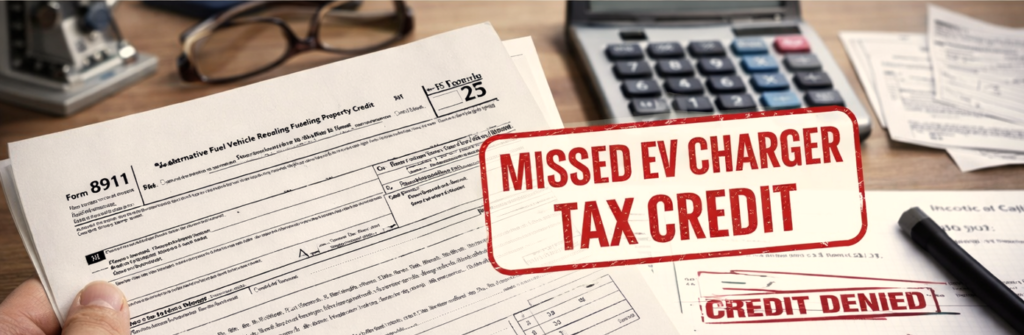
Under OBBBA (Public Law 119-21), the EV charger credit follows specific compliance standards. It requires proper installation, qualifying location, and accurate filing using IRS Form 8911 (Rev. December 2025). Even small mistakes can result in a denied claim.
This guide explains the risks of missing the EV Charger Credit, the IRS rules that cause denials, and real homeowner scenarios that show how quickly savings can disappear.
Why Missing the EV Charger Credit Can Be Financially Costly
The Section 30C credit covers 30% federal credit of qualified EV charger costs. For most homeowners, that equals $600 to $1,500 in savings.
Without the credit, you pay full cost.
Typical expenses include:
- Level 2 charger: $500–$900
- Installation labor: $800–$2,000
- Permit fees: $100–$300
- Electrical panel upgrades (if required): $1,000+
If your total project cost is $2,500, the credit could reduce your tax liability by $750. Miss it, and that money is gone.
There are no extensions. No amended claims after expiration. No “good faith” exceptions.
One common misunderstanding is assuming the payment date matters. It does not. The IRS looks at the “Placed in Service” date — when installation is fully completed and operational. If inspection finishes after the deadline, eligibility may be lost.
Timing determines everything.
IRS Rules That Commonly Trigger Denials
Many homeowners qualify but still lose the credit because of paperwork errors.
Here are the most common IRS compliance issues:
1. Incorrect Form Version
You must use IRS Form 8911 (Rev. December 2025). Older versions may not include required location attestations.
2. Missing Schedule A Per Charging Port
Each charging port requires its own Schedule A attachment. Filing one schedule for multiple ports can trigger rejection.
3. Census Tract Qualification
Eligibility depends on whether your home is located in a qualifying low-income or non-urban census tract. The IRS requires the 11-digit GEOID code — not just a ZIP code.
ZIP codes are not sufficient proof.
4. Placed-in-Service Verification
The charger must be fully installed and operational before June 30, 2026. In some cases, inspection approval may be required to establish compliance.
5. Incomplete Documentation
You should retain:
- Equipment receipts
- Installation invoices
- Permit records
- Proof of completion date
The IRS may request substantiation during review.
Most denials happen because homeowners assume installers handle tax compliance. They don’t. Filing responsibility remains with you.
Read Also: Secure Your Federal EV Charger Tax Credit Now 2026
Real Stories From Homeowners
These scenarios are based on common compliance mistakes seen in recent filings.
Story 1: The One-Day Delay
A homeowner scheduled installation for June 29, 2026. The electrician completed physical wiring that day. However, the city inspection occurred July 1.
The charger was not considered fully “Placed in Service” until inspection passed.
Result: $1,200 credit lost.
Lesson: Build buffer time into your installation schedule.
Story 2: The Wrong Location Verification
Another homeowner verified eligibility using their ZIP code. They filed Form 8911 assuming qualification.
Months later, the IRS requested the 11-digit census tract GEOID. The property was located just outside a qualifying boundary.
Result: Credit denied.
Lesson: Always confirm census tract status using official mapping tools and retain proof.
Story 3: Non-Certified Equipment
A homeowner purchased a discounted charger online. It lacked proper certification documentation.
During review, the IRS questioned equipment eligibility.
Result: Claim disallowed.
Lesson: Purchase qualified, compliant Level 2 charging equipment from reputable manufacturers.
Also Read Alternative Fuel Vehicle Refueling Property Credit
Step-by-Step Actions to Avoid Missing the Credit
The best defense against denial is preparation.
Step 1: Confirm Census Tract Eligibility Early
Before purchasing equipment, verify your 11-digit GEOID census tract status. Save a screenshot or PDF confirmation.
Do not rely on ZIP codes.
Step 2: Choose a Qualified Level 2 Charger
Select a charger that meets federal requirements. Confirm documentation is available from the manufacturer.
Avoid uncertified discount models.
Step 3: Schedule Installation Well Before the Deadline
Contractors become busy near program expiration dates. Book installation at least 60–90 days before June 30.
Confirm inspection timelines in writing.
Step 4: Complete IRS Form 8911 Properly
When filing:
- Use the correct revision (December 2025)
- Attach Schedule A for each charging port
- Accurately allocate costs
Double-check calculations before submission.
Step 5: Maintain Complete Documentation
Keep both digital and physical copies of:
- Receipts
- Contractor invoices
- Permit approvals
- Completion confirmation
Store them for at least three years.
Risk Avoidance Checklist
- □ Verified qualifying census tract
- □ Selected compliant equipment
- □ Installation completed before deadline
- □ Schedule A filed per port
- □ Saved all invoices and approvals
Cost Breakdown: What You Lose If You Miss It
Here is a simple comparison:
| Scenario | Total Cost | Federal Credit | Final Cost |
|---|---|---|---|
| Credit Claimed | $2,500 | $750 | $1,750 |
| Credit Missed | $2,500 | $0 | $2,500 |
The difference is significant.
In some regions, homeowners can also stack utility rebates. However, if you miss the federal credit deadline, those additional savings may not offset the full loss.
Once expired, the federal credit cannot be reinstated.
Common Mistakes That Lead to Missed Credits
Most missed credits are preventable.
Frequent mistakes include:
- Waiting until the final month
- Assuming installer guarantees approval
- Filing with incorrect census tract data
- Forgetting Schedule A attachments
- Misunderstanding the placed-in-service rule
- Rushing installation without confirming inspection timing
Contractors focus on electrical work. Tax compliance is your responsibility.
Delays and documentation gaps create risk.
Practical Tips to Protect Your 2026 Savings
If you want certainty, start early.
- Begin the process at least three months before expiration
- Confirm installation and inspection dates in writing
- Set digital reminders for filing deadlines
- Review Form 8911 instructions carefully
- Consult a tax professional if unsure
Avoid last-minute decisions.
A structured plan protects both compliance and savings.
FAQs
Can I still claim the EV vehicle credit in 2026?
No. The federal vehicle credits (Sections 30D and 25E) ended September 30, 2025. Only the charger credit remains active until June 30, 2026.
What happens if installation completes after June 30, 2026?
If the charger is not fully placed in service by the deadline, the credit is not available. There are no retroactive exceptions.
How do I verify if my home qualifies by census tract?
Use an official census mapping tool to locate your 11-digit GEOID. Confirm whether it meets low-income or non-urban eligibility requirements. Retain proof for your records.
Do multiple chargers require multiple Schedule A forms?
Yes. Each charging port requires a separate Schedule A attachment when filing Form 8911.
Can utility rebates still apply if I miss the federal credit?
Utility rebates may still apply independently, depending on your provider. However, the federal 30C credit cannot be recovered after expiration.
Conclusion: Act Before the Deadline
The risks of missing the EV Charger Credit are real. Financial loss. IRS rejection. No second chances.
The deadline of June 30, 2026 is firm. Eligibility depends on installation completion, proper documentation, and accurate filing.
If you plan to install a home EV charger, verify your census tract, schedule installation early, and prepare your IRS documentation carefully.